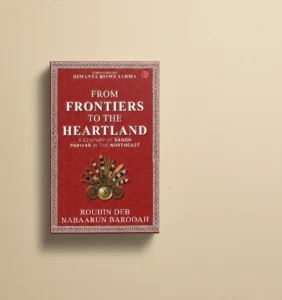
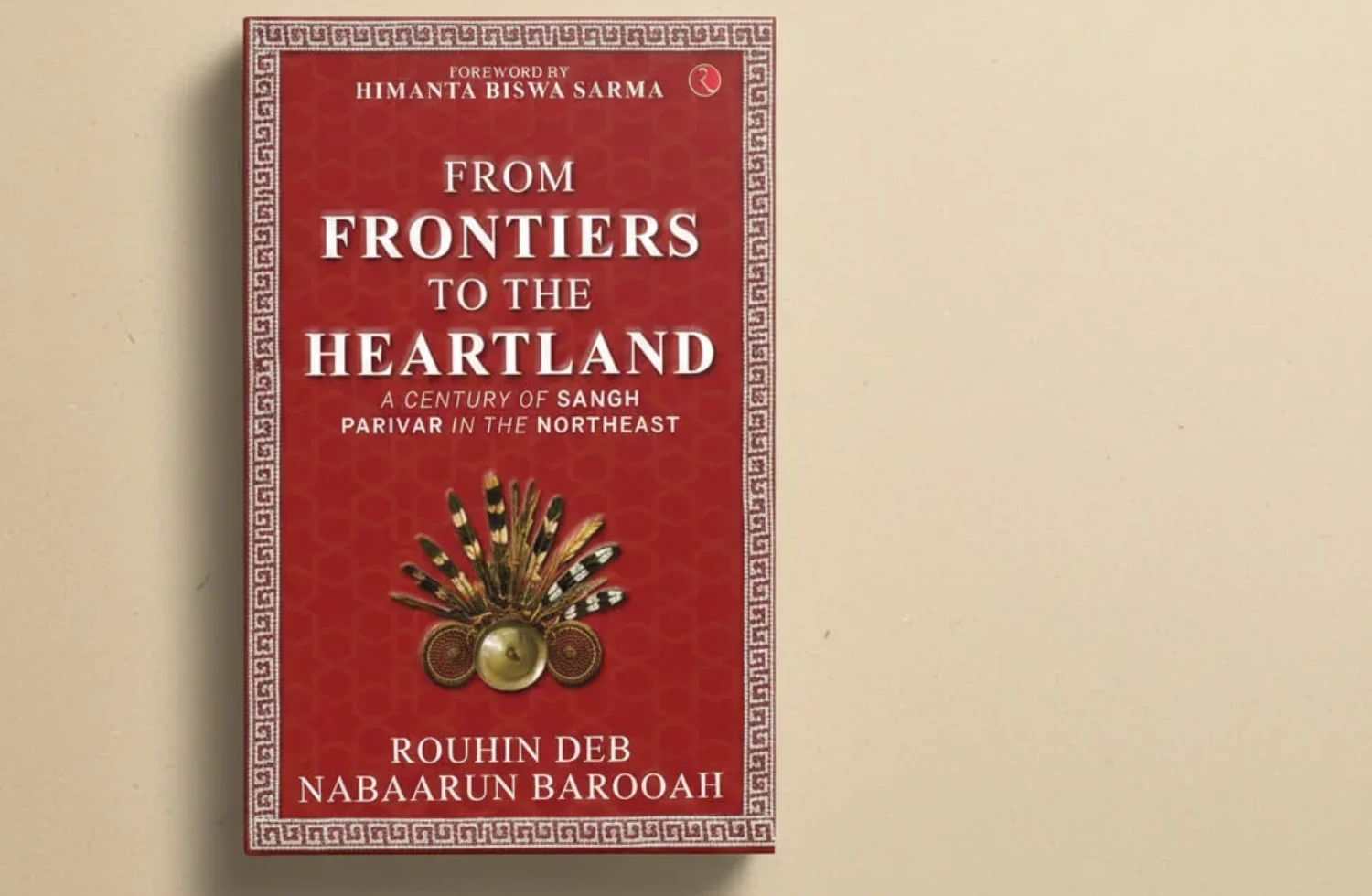
India’s Northeast has often been portrayed as a remote “frontier” – a culturally diverse and frequently turbulent region misunderstood by the rest of the country. In From Frontier to the Heartland: A Century of Sangh Parivar in the Northeast (2025), authors Rouhin Deb and Nabaarun Barooah turn that idea on its head. Through meticulous research and engaging narrative, they reveal how the Hindu nationalist Sangh Parivar (the family of organizations including the RSS and BJP) steadily became woven into the fabric of this distant region over a hundred years. This positive and insightful book review explores the major themes and significance of their work, explaining what makes it a unique and essential read for anyone interested in political history, cultural identity, and Northeast India.
Historical Context: Northeast India and the Sangh Parivar
The Northeastern states – Assam, Arunachal Pradesh, Nagaland, Manipur, Meghalaya, Mizoram, Tripura and others – cradle some of India’s richest cultural diversity. This “sisters” region (as the book notes) is home to dozens of ethnic communities, indigenous faiths, and languages. Historically, it faced its share of upheaval: colonial-era policies like the Inner Line Permit (ILP) sought to protect tribal lands, while post-independence India saw waves of insurgencies, mass migrations, and religious conversion drives that profoundly shaped local politics. In this context, Hindutva – the ideology of Hindu nationalism championed by the Sangh Parivar – seemed an odd fit. The mainstream narrative often assumes the Sangh Parivar as an outsider, rooted in the Hindi heartland, imposing its agenda on peripheral states.
Deb and Barooah challenge that assumption. They show how the RSS (Rashtriya Swayamsevak Sangh) and affiliated groups gradually engaged with the Northeast on its own terms. Instead of bulldozing local identities, the Sangh Parivar personnel immersed themselves in village life, learned indigenous customs, and opened institutions – from schools to healthcare clinics – that served these communities. Over time, even the Northeast’s “hyper-local” cultures have come to include Sangh Parivar affiliates as familiar parts of the landscape. This book reframes the Northeast not just as a contested borderland, but as an active participant in the larger Indian story – a new “heartland” for Sangh Parivar ideas.
Key Themes and Insights
Deb and Barooah organize the book thematically and chronologically, weaving together historical analysis, personal stories, and on-the-ground reporting. Several key insights emerge:
Cultural Adaptation and Respect for Traditions: The book highlights the Sangh Parivar’s surprising willingness to integrate with local faiths. Instead of erasing indigenous religions, Hindu nationalist affiliates often helped preserve and formalize them. For example, in Arunachal Pradesh the authors show how RSS-led groups acknowledged Donyi-Polo (the local sun-and-moon worship) by organizing festivals and dialogues, rather than dismissing it. In Manipur and Assam they document Sangh supporters working with Sanamahism and practices of tribal faiths, treating them as important threads of a shared civilizational tapestry. In each case, the Sangh Parivar personnel are portrayed not as outsiders enforcing a single vision of Hinduism, but as participants in the culture. This approach, Deb and Barooah argue, helped make Hindu nationalist ideas more palatable and genuine in the Northeast’s plural landscape.
Service (Seva) and Community Work: A major theme is service to society. The authors recount numerous instances where Sangh activists (often called “pracharaks” or “swayamsevaks”) built schools, health clinics, and relief programs in remote areas. One vivid episode is the 2020 COVID-19 lockdown: several RSS teams quietly returned to villages they had visited before and provided food, medicine, and aid to families – even in places where locals had once viewed them with suspicion. These humanitarian efforts are presented as part of a long strategy. By meeting basic needs and supporting communities in crisis, the Sangh Parivar organizations earned trust and showed a different face of Hindutva – one grounded in social welfare rather than political rhetoric.
Adaptability and Local Engagement: The book emphasizes how Sangh activists adapted to the Northeast’s distinct lifestyles. A memorable detail is how vegetarian RSS workers from the plains learned to accept meat-eating customs in many tribal societies as part of their “seva.” Similarly, the authors describe how volunteers learned local languages and participated in village councils to build relationships. This flexible, “on-the-ground” style of work is contrasted with the more confrontational image of Hindu nationalism in other parts of India. Deb and Barooah effectively argue that in the Northeast the Sangh Parivar developed a malleable Hindutva – accommodating customs and grievances rather than insisting on uniformity.
Historical Encounters: The narrative spans from British colonial times to the present. It documents early Sangh Parivar efforts in Assam and surrounding areas even before Independence, noting how missionaries, migration, and state policies created cultural fault lines that both challenged and engaged the Sangh vision. Post-1947, the book covers events like the 1970s Emergency, ethnic unrest, and debates over illegal immigration from Bangladesh – all through the lens of how Sangh workers responded. The recurring message is resilience and persistence: the Sangh Parivar is shown continuously “pushing back” against forces (whether it’s militancy or cultural change) by organizing communities and education.
Bridging Divides: Perhaps the book’s overarching insight is how the Sangh Parivar navigated the Northeast’s “socio-cultural, political and religious divides”. Deb and Barooah pay special attention to moments when the Sangh Parivar acted as a bridge – for example, when local activists set up joint cultural events for Hindus and tribal groups, or when former opposers came to see Sangh schools as valuable educational resources. Their interviews with long-time workers and villagers illustrate that over decades, perceptions changed: many in the Northeast now recognize these organizations as part of the local social fabric, even as they debate identity issues.
Major Insights from the Book
-
Grassroots Service: The Sangh Parivar expanded its influence largely through community service (education, healthcare, disaster relief), embedding itself via tangible benefits to local people.
-
Cultural Syncretism: Instead of eroding indigenous traditions, Sangh affiliates often supported and codified them, demonstrating respect for Donyi-Polo, Sanamahism, and other native faiths.
-
Adaptation of Practices: Volunteers from the heartland learned local languages, diets, and customs (e.g. accepting meat-eating communities) to build trust – a pragmatic approach seldom highlighted in mainstream accounts.
-
Challenges Confronted: The book recounts how Sangh workers persisted despite hostility or violence, returning to conflict zones after unrest subsided to assist in rebuilding, showing their commitment.
-
Long-term Vision: Rather than immediate political victories, the Sangh Parivar’s strategy in the Northeast is depicted as a slow, steady one – focusing on cultural education (via shakhas and organizations) and social welfare, laying the groundwork for future political presence.
Narrative and Writing Style
Despite its scholarly research, From Frontier to the Heartland is written in an accessible, narrative-driven style. Deb and Barooah balance academic rigor with engaging storytelling. Readers will find firsthand accounts, vivid anecdotes, and clear explanations. The text flows chronologically but is arranged around these major themes, so the reader always sees how each chapter’s stories fit into the bigger picture.
The authors’ diverse backgrounds (an economist and a historian-political commentator, both deeply familiar with Assam and the Northeast) shine through. They cite interviews with local activists, excerpts from memoirs of RSS veterans, and relevant archival sources – yet the prose never feels bogged down in jargon. Instead, it comes across as a well-told chronicle or journalistic piece. This makes the book suitable not just for academics, but for general readers curious about modern India. By humanizing the narrative (for example, profiling a teacher from a hill village who became an RSS pracharak), the writing style keeps the reader connected to real people behind the broad ideological story.
Unique Contributions and Significance
What makes From Frontier to the Heartland stand out is how it fills a gap in Indian political and regional history. Hitherto, studies of Northeast India often focus on tribal politics, insurgency, or colonial legacies – rarely on the full arc of Hindu nationalism in the region. Conversely, most Hindutva histories center on central and northern India. Deb and Barooah’s book bridges these worlds, mapping a century-long Hindutva journey that spans Assam to Arunachal Pradesh.
Compared to other works, this book is noteworthy for its scope and positivity. It does not simply criticize the Sangh Parivar or dismiss its influence; instead, it presents a balanced portrayal emphasizing constructive aspects. In doing so, it challenges academic biases that assume the Sangh’s presence in the Northeast has been purely polarizing. For example, recent scholarly books (like Arkotong Longkumer’s The Greater India Experiment) have examined Hindutva in the Northeast through an ethnographic lens. Deb and Barooah’s work complements those studies by offering a broader narrative combining political history, interviews, and on-site observation. In short, it’s both pioneering and comprehensive.
The book’s timing and impact are significant. Published in mid-2025, it arrives after a decade of dramatic political changes in the Northeast – such as multiple states falling under BJP-led alliances and rapid infrastructural development. Understanding these changes requires knowing their roots, and Deb and Barooah provide that historical context. They show how today’s election victories and the prominence of Northeast leaders in national politics are not spontaneous, but the result of decades of groundwork.
Moreover, by highlighting stories of service and identity, the authors invite readers to rethink what nationalism and belonging mean in a region long stereotyped as disconnected from “mainstream” India. They argue convincingly that the Sangh Parivar’s brand of nationalism in the Northeast cannot be seen as monolithic; it has been shaped by local realities. This insight has broader relevance: as India grapples with issues of diversity and unity, this book illustrates a model (and debate) of integration that goes beyond mere political rhetoric.
Writing Style and Accessibility
Deb and Barooah succeed in making a complex subject accessible. The tone is positive and informative throughout. Their prose is clear and engaging, peppered with compelling quotes from local figures and colorful descriptions of villages and events. Readers don’t need to be experts in Indian politics to follow the narrative, yet advanced readers will appreciate the depth of context and data provided. Headings, subheadings, and occasional maps or timelines (if included) help guide the eye.
Importantly, the authors avoid heavy academic language. They explain terms (like seva, pracharak, Hindutva) in plain English and provide context for the Northeast’s states. This makes the book suitable for a general blog audience, students, or anyone curious about Indian current affairs. At the same time, there are enough references and a thorough bibliography (as noted by reviewers) to satisfy scholarly readers. The result is a highly readable book that educates without talking down to its audience.
What Makes This Book Unique
First-of-its-kind focus: Few books have tackled the century-long evolution of Hindutva in the entire Northeast. Deb and Barooah’s multi-state, multi-decade approach is unprecedented.
Insider perspectives: The authors themselves have lived in and worked on Northeast policy. This insider view, combined with interviews of grassroots workers, brings authenticity that outside observers often lack.
Comprehensive research: Drawing from newspapers, official documents, oral histories, and unpublished memoirs, the book’s scholarship is unparalleled in this niche field.
Positive framing: While acknowledging controversies, the book consistently highlights constructive efforts. It frames the Sangh Parivar’s story as one of adaptation and dialogue, not just conflict.
Broad relevance: The themes of cultural preservation, identity politics, and grassroots activism resonate far beyond the Northeast. This makes the book useful for understanding similar dynamics in other regions or countries.
Significance and Impact
Since its release, From Frontier to the Heartland has attracted attention from scholars, policymakers, and media. It is already being called essential reading for anyone interested in Indian nationalism or the Northeast. By giving voice to local experiences of Hindutva, it encourages readers to discuss how ideology meets everyday life in a frontier region.
For political analysts, the book offers clues to the future. Understanding that the Sangh Parivar spent decades winning hearts and minds helps explain why parties like the BJP now have footholds in the Northeast. For social scientists, the book is a case study in how a major political movement can reconcile with indigenous diversity. And for general readers, the vibrant stories – from remote villages where an RSS shakha first started, to town halls where tribal youth debate identity – make for fascinating reading.
Ultimately, Deb and Barooah’s work broadens our view of Indian history. It suggests that the Northeast is not merely a distant outpost, but a dynamic participant in the making of modern India. The narrative invites us to question assumptions: perhaps we have underestimated how local cultures can shape, and be shaped by, national ideas.
In sum, From Frontier to the Heartland is a bold, thoroughly researched, and highly readable account of an untold chapter in India’s story. Its themes of cultural integration, community service, and adaptive nationalism are brought to life through compelling storytelling. For anyone seeking a deeper understanding of Hindutva, regional identity, or Northeast Indian society, this book provides fresh perspectives that linger long after the last page. It stands as a pioneering work that redefines how we think about the Sangh Parivar’s journey from the farthest frontiers to the heart of national life.
Final Verdict:
From Frontier to the Heartland is a thoughtful, well-researched, and quietly persuasive book that fills a long-ignored gap in India’s political and cultural history. It succeeds not by shouting ideology, but by patiently documenting lived realities, grassroots work, and cultural negotiations across a century. Whether you agree with the Sangh Parivar or not, this book is essential reading for understanding the Northeast beyond stereotypes—and for seeing how long-term social engagement can reshape a region’s place in the national imagination.
Narrative: 4.5/5
Objective: 4/5
Writing: 4/5
Overall: 4/5
Genre & Themes: Cultural & Ethnic Studies, Sociology, Political Science