
What if success without Dharma is merely ambition without anchor?
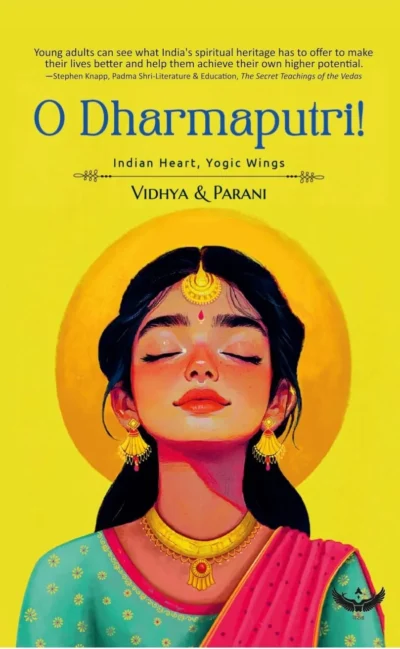
O Dharmaputri book review begins with something rare in modern reading experiences. It begins with gratitude. I did not simply finish this book. I felt enriched by it. I felt steadied. And most importantly, I felt genuinely happy that I chose to read it.
Written as an intimate letter from parents to their daughter, O Dharmaputri! Indian Heart, Yogic Wings offers a deeply reflective journey through Dharma, Shakti, Yoga philosophy, and Indian civilizational wisdom. It is at once personal and expansive. It is rooted in ancestry yet firmly aware of modern dilemmas.
What Is O Dharmaputri About?
At its heart, O Dharmaputri! is about responsibility. Not the burdensome kind imposed from outside, but the conscious kind chosen from within.
The narrative begins with family history during colonial India. We encounter stories of sacrifice that are not romanticised but lived. A man refuses parole from prison because it requires him to abandon the freedom movement. His wife has passed away. He has never seen his newborn child. Yet he chooses integrity over personal relief.
That singular episode frames the entire book.
Dharma is not introduced as ritual. It is revealed as moral courage.
From there, the scope widens. The authors discuss India’s intellectual heritage, ancient universities, philosophical debates, and mathematical advancements. They reclaim a civilizational narrative often reduced to stereotypes. Yet they do so with calm conviction rather than exaggeration.
Dharma and Shakti in Modern Life
One of the most compelling aspects of this O Dharmaputri book review is its treatment of Shakti. Womanhood is not portrayed as passive reverence. It is articulated as dynamic strength.
The daughter addressed in the book is encouraged to pursue professional excellence without sacrificing spiritual clarity. She is reminded that ambition and Dharma are not adversaries. They are companions when guided by discernment.
The book repeatedly draws from the Isha Upanishad, which advocates the pursuit of both material knowledge and spiritual wisdom. That balance becomes the spine of the narrative. It rejects the false binary between success and sanctity.
As I read these sections, I found myself reconsidering common assumptions about achievement. We are often told to chase passion. Rarely are we asked to examine responsibility. This book reframes that conversation with nuance.
Yoga Philosophy Beyond Posture
In contemporary culture, Yoga is frequently reduced to physical flexibility or aesthetic wellness. O Dharmaputri! restores its philosophical depth.
The discussion of Yamas and Niyamas is presented not as rigid commandments but as tools for ethical clarity. Yoga becomes a discipline of perception. It sharpens the ability to distinguish ego from duty. It refines the mind before it disciplines the body.
What I appreciated most was the accessibility of the explanation. The authors do not overwhelm the reader with excessive terminology. Nor do they dilute complexity. The language remains articulate yet intimate.
Why O Dharmaputri Feels Relevant Today
In an era defined by productivity metrics and social validation, the message of this book feels steadying.
It asks quiet but powerful questions.
What is the meaning of success if integrity is compromised?
What is progress if it erodes character?
What legacy are we building if we forget the foundations that shaped us?
These questions linger long after the final page.
What moved me personally was the reminder that we are not isolated individuals striving alone. We are continuations. Our decisions ripple across generations. To be a Dharmaputri is not merely to inherit tradition, but to embody ethical awareness.
That insight left me unexpectedly grateful.
Final Thoughts on This O Dharmaputri Book Review
This O Dharmaputri book review concludes with sincerity. I am genuinely happy that I read this book.
It did not offer simplistic motivation. It did not promise instant transformation. Instead, it restored proportion. It reminded me that integrity remains timeless, and that ambition acquires meaning only when anchored in Dharma.
For readers interested in Indian spiritual wisdom, Yoga philosophy, and the relevance of Sanatana Dharma in modern life, this book offers thoughtful engagement rather than superficial commentary.
Some books entertain.
Some books provoke.
This one steadies.
And in today’s restless landscape, that may be its greatest gift.
Narrative: 4.5/5
Objective: 5/5
Writing: 4.5/5
Overall: 4.5/5
Genre & Themes: Motivational, Self-Help
What is O Dharmaputri about?
O Dharmaputri explores Dharma, Shakti, Yoga philosophy, and Indian civilizational wisdom through a personal narrative addressed from parents to their daughter.
Does the book focus on religion?
While rooted in Sanatana Dharma, the book presents Dharma as an ethical and philosophical framework rather than rigid religious doctrine.
Is Yoga philosophy discussed in depth?
Yes. The book examines Yoga beyond posture, focusing on ethical discipline and inner clarity.
Why is O Dharmaputri relevant today?
It reframes success through the lens of integrity and responsibility, offering balance in an era driven by productivity and external validation.
Is O Dharmaputri suitable for young readers?
Yes. The book is particularly meaningful for young adults navigating ambition, identity, and responsibility.